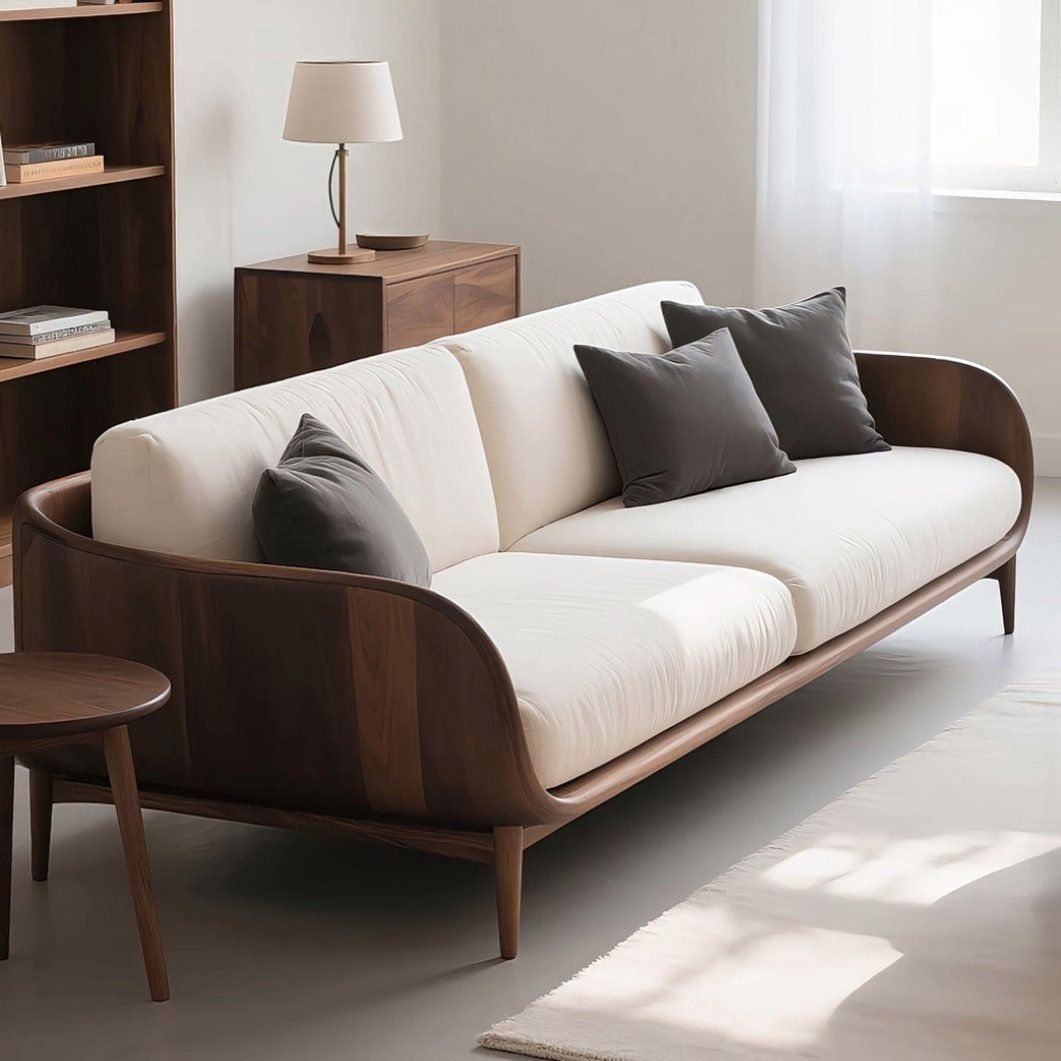
On a Tuesday morning in our Pune workshop, Ramesh has been at his station since seven. In front of him is a half-finished cushion back — Belgian linen, warm oatmeal, cut to precise dimensions the evening before. His needle moves in a rhythm that looks casual until you notice it never misses.
Ramesh has been doing this for twenty-two years.
Why Hand-Stitching Still Matters
In an era where upholstered furniture is increasingly manufactured by machine at industrial scale, we’ve held to hand-stitching for reasons that are partly philosophical and partly deeply practical.
The philosophical part: there’s something irreplaceable about knowing a human hand shaped the object in your home. That the seat of your sofa was formed, not extruded.
The practical part: machine-stitched upholstery, however consistent, cannot respond to the specific character of each material. A corner on a bouclé behaves differently from a corner on leather. Linen has a grain and a breathability that changes how it sits on a form. An experienced upholsterer reads these qualities and adapts, stitch by stitch.
The Process, Step by Step
1. Frame Construction
Every WoodItalia sofa begins with a hardwood frame, kiln-dried to remove moisture that could cause warping or creaking over time. Our frames are jointed with both wooden dowels and corner blocks — a construction method borrowed from traditional furniture-making that adds rigidity without adding weight.
2. Spring and Webbing
We use sinuous springs (also called no-sag springs) interlaced with high-tension jute webbing. This base layer determines the sofa’s longevity. Cheap sofas skip this step and rely entirely on foam, which compresses and loses shape within a few years.
3. Foam Selection
Not all foam is equal. We source high-resilience foam rated for longevity, with a density appropriate to each part of the sofa:
- Seat cushions: Higher density, firmer support
- Back cushions: Medium density, more give
- Arm padding: Lower density, primarily for shape
For our premium range, we wrap the foam in Dacron — a polyester batting that softens the profile and gives cushions that slightly overstuffed look that never goes out of style.
4. Cutting and Marking
Before any fabric touches a needle, our pattern-makers cut every piece with precise allowances marked in chalk. A three-seater typically has 40–50 individual fabric pieces. For a U-shape, that number can exceed 100.
Patterns are matched at this stage — critical for fabric with a repeat, like geometric prints or large-scale botanicals.
5. Stitching and Assembly
This is where Ramesh and his colleagues spend most of their time. The outer panels are sewn on industrial machines for straight seams, but the crucial finishing — the corners, the welt cords, the buttoning — is done by hand.
A well-made welt cord is the invisible signature of quality upholstery. You rarely notice it consciously, but its absence is immediately apparent.
6. Finishing and Inspection
Before a sofa leaves our workshop, it goes through a three-stage inspection: structural (frame integrity, spring tension), aesthetic (fabric alignment, seam quality), and comfort (seat depth, cushion fill, back support). Any sofa that doesn’t pass all three stages goes back for revision.
If you’d like to see the process in person, we welcome studio visits. Get in touch and we’ll arrange a time.